 Home Depot
 06:3406:3401:5300:3411:52
A storage unit business (the self storage business) rents lockable units, parking spaces or fenced yards by the month. Most owners in these videos bought an existing facility instead of building one, usually with a loan or seller financing. The day-to-day work is collecting rent, fixing doors and roofs, marketing and handling the occasional auction.
Owners use this same check to judge local demand and to estimate a competitor's income: units × rent × occupancy. 02:2102:4008:51
Each clip opens at the exact moment on YouTube.
08:51 28:03
 02:46
 17:16
 02:34
 00:15
You buy (or, less often, build) a set of metal buildings, containers or a fenced lot, divide it into units and rent them month to month. Revenue is roughly rentable square feet × rent per square foot × occupancy. Running costs are low compared with apartments, at about 25–40% of revenue, but you're usually carrying a large loan, and property taxes, repairs and marketing all come out before you're paid. Owners say the best deals are small, under-managed facilities whose rents are below market. Building new means zoning, permits and 2–3 years to fill up. 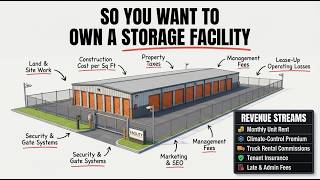 05:2204:4406:0302:1108:08
Four quick questions about the day-to-day work the creators describe.
Real US Google searches, and an example of local competition. Data from DataForSEO, 2026-11-24.
00:5002:2802:4013:3706:3403:41Your money is tied up in land and buildings, and most of the price is usually borrowed: lenders want 25–30% down. A new build can lose money for 12–18 months while it fills. One first-time builder had to add $296,000 of his own cash when the appraisal came in low. No source gave a forced-sale price, so we don't show a worst-case figure. 04:0608:3122:35
Our estimate In years, before loan interest. One owner paid $75,000 for a small-town facility that brings in about $24,000 a year. Take off about $1,400 of property tax and roughly $700 a year of repairs ($2,000 over 3 years) and about $21,900 is left, so it pays for itself in about 3.5 years. A stabilized facility bought at a 5–6% cap rate takes 17–20 years of net income to repay its price (1 ÷ 0.06 ≈ 17). That's why buyers use loans and look for under-managed sites. 06:3401:1710:3811:4403:16
The order these owners and builders recommend: study the local market, buy before you build, and automate from day one. Tick steps as you go; progress saves on this device.
03:3304:2022:2007:29Here's a one-page plan filled in with this guide's figures. Swap in your own market's numbers from the feasibility study and your competitor calls. 13:5902:21
| Model | Buy a small existing facility in a smaller market, or start with an outdoor yard or containers on land you control 10:15 27:2408:28 |
|---|---|
| Startup budget | Median $150,000 of cash in these videos; $75,000 bought one small-town facility outright 06:3403:50 |
| Prices | $50–85 for small-town units; $80–150 for a suburban 10x10; $300–1,800 for outdoor yards 01:4610:1104:5810:0615:09 |
| Running costs | Upper 20s to 40% of revenue, including property tax, repairs and software; marketing $500–4,000 a month 04:4406:0326:3609:29 |
| Occupancy target | 80–85% is what one builder's peers see; new builds take 2–3 years to fill 24:4117:38 |
| Marketing |  Google,  Facebook groups and Marketplace, door hangers, local businesses  06:2326:4206:29 |
| Break-even | About 3.5 years on a cheap small facility; 17–20 years at a 5–6% cap rate before leverage (our estimate) |
Most of these owners bought first. An existing facility has tenants and rent from day one, and sellers sometimes finance part of the price. Building can pay off in an undersupplied market, but it takes years of permits and lease-up. About 22,200 people a month search for self storage for sale. 08:1217:38
| Option | What the sources say | Sources |
|---|---|---|
| Buy a small existing facility | $75,000 in a small Ohio town; a commentator puts the typical range at $1.5M–4M | 06:3403:41 |
| Buy an under-managed facility | $2.5M for 50,000 sq ft plus repairs; revenue later rose from $30K to $50K+ a month | 00:0806:55 |
| Build new | $1.98M for a first-time rural build; $3M–6M in a mid-size market; 2–3 years to fill | 28:0302:3808:08 |
| Seller financing | $120,000 down on a 15-year note; another deal at 20% down and 3% | 03:5003:4520:11 |
| Outdoor yard or containers | Lease land or partner with a landowner; containers cost about $2,500 each | 08:2806:31 |
03:1606:3206:3432:5733:16A checklist drawn from owners who have bought facilities. Many small ones are mom-and-pop sites that aren't run like a business. 01:0402:11
| Check | Why | Sources |
|---|---|---|
| Competitors' availability and prices | Waiting lists mean room to raise rents; free-month offers mean oversupply | 02:2802:40 |
| Rent roll vs street rate | Long-time tenants may be paying half today's price | 02:58 |
| Delinquent units | Up to 5–10% of units may be late or not paying | 03:48 |
| Roof, drainage and doors | Look for stains in vacant units, ideally during heavy rain | 05:3205:12 |
| Locks and gate codes | Owner-held keys and tenant-set codes cause headaches | 07:0205:51 |
| Property taxes after the sale | One builder's tax bill came in $40,000 higher than expected | 19:03 |
None of these owners started with nothing. These are the lowest-cash routes they describe. A container storage business or an outdoor yard still needs land and the city's permission. 07:2908:28
| Route | How it works | Sources |
|---|---|---|
| Partner with a landowner | They bring the land, you bring the business, and you share the profit | 08:28 |
| Lease land with an SBA loan | About $35,000 down on a $350,000 leased-yard project | 37:1425:11 |
| Seller financing | Pay a retiring seller what they need each month; one deal was $150,000 up front, then $5,000 a month | 19:1327:24 |
| Shipping containers | About $2,500 each, renting for $50/mo, but most municipalities won't allow them | 06:3106:3707:29 |
| Converting an existing building | One founder rents out an old warehouse on his land while it goes through permits | 27:1934:50 |
| Bring in investors | They get a preferred return; you get paid to manage | 29:0829:59 |
Storage unit zoning decides whether you can build at all, and permits add time and cost. These are the figures sources gave. Check your city, county and state rules; none of this is legal advice. 03:3334:50
| Item | What it cost or took | Sources |
|---|---|---|
| Rezoning, civil engineering and drawings | ~$50,000, spent before he knew the answer | 04:0904:20 |
| Excavation on a sloped lot | ~$400,000 | 30:42 |
| Single-story construction | $25–45/sq ft (a commentator); $73/sq ft on one small first phase | 01:5733:16 |
| City fees | Half a million dollars on one Arizona project | 13:36 |
| Wetlands credits | $70,000 → $130,000 an acre during one project | 05:21 |
| City requirements | One city required an on-site office | 22:20 |
| Time | Over two years of planning on one build | 10:12 |
00:1500:3509:2709:34 09:30Google search and ads
People search “storage units near me” and pick a nearby option. One commentator says $1,500–4,000 a month on digital marketing is normal for a mid-size site.
09:2209:2900:50Facebook groups and MarketplaceFree community-group posts helped one builder fill 285 units in 82 days; the yard founder posted on Marketplace
06:2300:4511:57Rents vary a lot by town and unit type. These are the figures the sources gave.
| Job | Price | Sources |
|---|---|---|
| 5x5 | $30–80/mo | 04:50 |
| 10x10, suburban / dense urban | $80–150 / $150–250 | 04:58 |
| 10x20 | $150–350/mo | 05:09 |
| Small-town units (Ohio, Wisconsin) | $50–85/mo; some tenants would pay $150 | 01:4610:1102:04 |
| Indoor boat or camper unit, winter | $165 gravel floor, $200 concrete | 04:15 |
| Shipping container | $50/mo (the owner thinks that's cheap) | 06:37 |
| Boat or RV spot (estimate) | $100–500/mo | 03:11 |
| Outdoor contractor yard | $300–1,800/mo by size | 10:0615:2515:09 |
| Climate-controlled premium | +20–40% | 05:17 |
| Late fee | $15–25 | 06:57 |
02:2102:2801:4201:4602:0819:1303:2508:0500:3511:4203:2505:4411:2803:1503:2602:3407:2203:0800:5019:5408:1206:5134:5802:3408:1007:1610:3010:1811:3013:5912:5202:21The mistakes the creators say they made, ranked by how many of them mention it.
01:0901:2010:2710:1213:5908:3117:4019:0313:3630:4230:5005:2110:12These storage unit business profit and revenue figures are monthly and come only from the owners' own facilities. Big-company figures and napkin maths are listed separately below.
04:3824:5424:38* Net operating income is before loan payments. The 50,000 sq ft facility cost $2.5M plus about $800,000 of the owner's cash, and the yard project cost about $3.5M, so these are large investments, not side hustles. A first-time builder's facility was 40–45% full after a year; he projects about $349,000 a year once it's full.
10:2510:4312:3442:4343:4143:3504:4006:3108:2806:3402:4603:4802:3425:5827:2429:0829:5902:13Real operators from the source videos. Results are as they told them.
06:3406:3401:5300:3411:5203:1503:1503:3330:4228:0317:3104:4104:4110:1200:4512:1912:1924:3824:5403:5003:5003:4506:3106:3703:1509:4805:1205:4402:4013:3725:4619:0308:4408:0817:3110:1207:5408:27Labels show whether each speaker runs the business and whether they sell something. Dates are approximate, from YouTube's “x years ago”.